Friday, January 27, 2006
Harper to Move Forward on Accountability Act
There is NO difference in what I have asked for for five years. I went to Valeri reporting an RCMP conspiracy, wanting the RCMP to be held accountable for ineptness in their white collar investigations, causing irreparable damage to innocent Canadians, (now uncovered by MacLean's magazine).
Laws are enacted by parliamentarians. He was my MP. If he had pushed for this, my case would HAVE to have been investigated and my concept would have moved forward. Valeri did nothing. Why? Why? Why?
If Harper can push forward an Accountability Act for Politicians, then there is absolutely no reason an Accountability Act for Police could not be made law.... THAT WORKS!!??!!! And please make it retroactive!! I have to believe that by the time Maclean's reported it, Ottawa must have been cognizant of their corrupt force much, much earlier.... and if they did not, then Ottawa is more inept than I thought!!
Here's an update from today's Toronto Star on the investigations to be expected on past government corruption and scandal
_________________________________________________
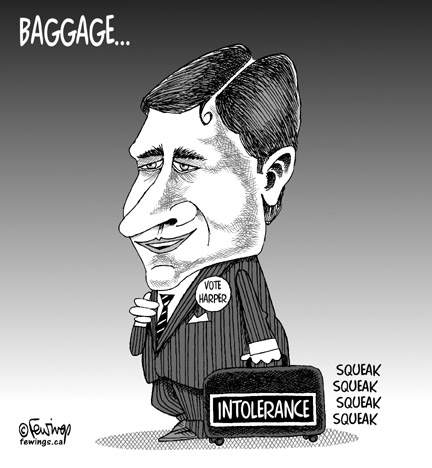 Harper may expose Liberals' skeletons
Jan. 27, 2006. 01:00 AM
BRUCE CAMPION-SMITH
OTTAWA BUREAU
OTTAWA—Stephen Harper is promising to pull back the curtain on yet more misspending by the outgoing government.
In his first news conference since winning Monday's election, Harper said he intends to make good on campaign pledges to open up government and launch legal action to recoup the $40 million he claims is still missing in the Liberal sponsorship scandal.
And he suggested that David Dingwall, the former Liberal cabinet minister who resigned as head of the Royal Canadian Mint, may be out of luck in his bid to get severance.
Dingwall quit his $277,000-a-year post in September after questions were raised about his expenses. He later told a Commons committee he was "entitled to his entitlements," including severance — a line that became the centrepiece of a Conservative campaign ad.
"We have never favoured paying a severance package to someone who voluntarily resigns. That's our understanding of the situation," Harper told reporters yesterday. "I'm going to be interested to see, when I get full briefings ... exactly what the legal situation is with regard to any negotiations with Mr. Dingwall."
The question for any new government is always how much to reveal of any skeletons found in the closet of the previous government.
And yesterday, Harper sounded like he was ready to throw the door wide open, starting with his promised accountability act.
That measure includes extending the Access to Information Act to cover all Crown corporations, Officers of Parliament, foundations and organizations that spend taxpayers' money, opening yet more of the government to greater scrutiny.
"There were a number of commitments in our platform and before the campaign to much further open up access to information. We're going to adopt those recommendations," said Harper, who'll take over as prime minister on Feb. 6.
He also signalled he would likely follow through on a vow to sue the Liberals to recover misspent sponsorship funds. The Liberal party has repaid $1.14 million to the government, but Harper has said up to $40 million remains unaccounted for.
"I've indicated in the past ... we intend to draw to the attention of the appropriate authorities the necessity of trying to recover the missing money," he said yesterday.
Harper also promised during the election that a Conservative government would launch an inquiry into federal spending on partisan public opinion polls.
While all this could add up to a heap of trouble for the Liberals, the Conservatives have little to gain from "picking" old fights with their political rivals, cautioned Nelson Wiseman, a political scientist at the University of Toronto.
"It wears off after a while... Piling on is a penalty in football and politics," he said yesterday.
Copyright Toronto Star Newspapers Limited.

Wednesday, January 25, 2006
Sound Familiar???? Finally! RCMP Corruptness Being Revealed. For me, Five Years Too Late.
 The Mounties give up
The RCMP is walking away from serious investigations, and failing to snag fraudsters, drug traffickers and white collar criminals
CHARLIE GILLIS
January 24, 2006
MacLeans
--------------------------------
from:
Our Roots: Greenfield Park, QC, + Fun Stuff (a Smile for Everyone, Everywhere, Every Day!)
Posted by me, January 5th, 2006 and why I asked for my friends to write their candidates, while these politicians were listening, for a commitment to check out my case after the election.......
"It was obvious from the outset that the NRPS did not understand white collar crime. In covering up their bungled investigation, they even whited out their police report, (which took months to procure through the Freedom of Information Act), proving they were hiding something.
Next, in a “Blue Brother Conspiracy”, the RCMP was inept enough to forward to us proof in writing, (now hidden away on the advice of a shocked retired Police Inspector), that they also bungled the investigation.
Our case proves a firm or individual in Canada does not stand a chance when he has been destroyed by the RCMP or other force. The justice and political systems “pull up the wagons in a circle” and refuse to assist."
---------------------------
January 25, 2008
Tony Valeri proceeded to block me from my rights to have the RCMP investigated by the simple refusal to do nothing for his constituent.
This was followed by Prime Minister Paul Martin's refusal to follow up on my complaint against his Minister, Tony Valeri.
These are my basic rights guaranteed by the Charter of Rights and Freedoms! Refused!
Canada is nothing short of a police state for those unfortunate enough to have a white-collar crime committed against them.
In my own case, it has cost cancer research up to $30,000,000 annually.
Thanks McLean's!
Thank you Friends, the ones who DID believe in me.
mike
Tuesday, January 24, 2006
The RCMP is walking away from serious investigations, and failing to snag fraudsters ....and white collar criminals
The Mounties give upThe RCMP is walking away from serious investigations, and failing to snag fraudsters, drug traffickers and white collar criminals
CHARLIE GILLIS
January 24, 2006
MacLeans
On the day of his graduation from the RCMP, red twill blazing and "high-browns" burnished to a lustre, Const. Keith Johnston, 27, is charting a dream career in law enforcement. From here at the Mounties' training academy in Regina, he's off to Didsbury, Alta., a quiet prairie town where he can learn the ropes of day-to-day policing. Then, with a few years under his belt, the native of Campbellford, Ont., plans to return to his home province, where elite RCMP units run many of their operations against the country's most elusive villains: terrorists, international mobsters, white collar criminals. To Johnston, these complex, high-stakes investigations are the stuff that sets the RCMP apart from other police services -- "that something," as he puts it, "that drew me to the Mounties."
Swearing-in day at Depot, as the training facility here is known, is a time for such blue-sky optimism -- a moment for grads to reflect with pride on joining the world's most iconic police force. But reality quickly intrudes. No sooner have Johnston and 27 fellow graduates scattered to postings across the country than the federal auditor general releases a report revealing that many of those positions he covets aren't actually getting filled. Newly released numbers show the Mounties have fallen some 600 officers, or 25 per cent, below normal strength in federal enforcement areas like drug interdiction and organized crime.
Their performance shows it. On drug offences, for example, clearance rates have fallen from nearly 80 per cent in 1995 to 61 per cent in 2004, according to numbers obtained from Statistics Canada (clearance rates are the proportion of incidents effectively solved through charges or other forms of resolution; they are a key measure of a police force's success). The Mounties' rate for other federal investigations -- from immigration fraud to stock market scams to smuggling schemes -- has been even worse, tumbling from highs near 80 per cent in the mid-1990s to 49 per cent in 2004.
And when Johnston speaks to some of his senior colleagues, the picture may seem even bleaker. In interviews with Maclean's over the past few weeks, officers from across the country have depicted a force losing effectiveness even as it receives more money and legal powers from the federal government. Detectives in federal units say they're being forced to ignore intelligence of criminal wrongdoing because they simply can't muster the manpower to investigate. The problem, they say, is that the force is preoccupied with fulfilling its contracts to communities where it supplies street-level policing. Yet patrol constables say they're overburdened, too. In increasingly serious cases, they say, officers routinely try to persuade crime victims not to press charges so they can close files more quickly. "If the public knew," says one officer based in British Columbia, "I think there would be a scandal."
Here lies the dilemma at the heart of the RCMP's ever-expanding mission. Can it answer the need for a nimble, well-staffed federal police agency while simultaneously patrolling the streets of The Pas, Man., or Burnaby, B.C.? Or by trying to do two things at once, are they doing neither well?
The issue seems all the more timely as high-stakes crime reclaims its place at the centre of the national conversation. Finance ministers in both Ottawa and Queen's Park have been drawn into market enforcement investigations over the past year, while the Gomery inquiry exhumed a network of political operatives defrauding the public with apparent impunity. Last fall, Bank of Canada governor David Dodge warned in a speech to RCMP brass that Canada risks becoming "a safe haven for opportunistic criminals who deal in white collar crime." These are matters the Mounties are specifically mandated to handle. Dodge for one is urging them to get busy.
Paul Palango, who has written two influential books on the RCMP, takes the argument one step further. The Mounties, he says, have been falling behind transnational and white collar criminals since the mid-1990s, and the single, galvanizing event since then -- the terrorist attacks of Sept. 11, 2001 -- have failed to prompt any wholesale reassessment, he says. "Nothing has changed. The RCMP's whole point has been to maintain the status quo." In the meantime, he notes, the Mounties have been defined by a well-publicized series of mishaps and investigative failures -- incidents reinforcing perceptions of disarray. The acquittal of suspects in the Air India bombing; the damaging allegations surrounding Maher Arar's deportation to Syria; the fruitless investigation of Brian Mulroney and the Airbus contracts -- all have called into question the Mounties' ability to handle big-time international cases.
On the patrol side, the fatal shooting in November of a teenager in Houston, B.C., and the drowning last summer of an officer wearing his body armour in Lake Okanagan gave rise to accusations of poor judgment or ill-preparedness. So too did the deaths of four officers near Mayerthorpe, Alta., at the hands of a well-known troublemaker. So even as all the major political parties line up to promise money and officers on the 17,000-member force, the troubling question lingers: are the Mounties up to the job?
The RCMP takes these perceptions seriously -- enough to fly a senior officer from Ottawa to Regina to show a reporter what it's doing to replenish its ranks and meet the myriad demand for its services. Courtly and soft-spoken, Insp. Glen Siegersma is the kind of Sam Steele figure the RCMP has purveyed publicly since its inception 132 years ago, and that polls suggest many Canadians still revere. At Depot's monument to fallen officers, Siegersma unfailingly pauses to salute. When cadets snap to attention upon seeing his officers' insignia, he thanks them for their fealty.
These qualities, along with his basic candour, make Siegersma the perfect officer to head the RCMP's recruiting "renewal initiative," the closest the force has ever come to a nationally coordinated recruiting campaign. In each of the next two years, the organization hopes to turn out some 1,600-plus new officers, fully 60 per cent more than the 2005 output. On one level, this response reflects the crisis every government agency faces due to retiring baby boomers. According to the auditor general, vacancies across the RCMP could reach 3,500 by 2010. "I think we'd be foolish not to look into the future, at the demographic trends, and not prepare ourselves," says Siegersma. It's also a way to show they're addressing policing problems slowly coming to public attention. Whatever role the RCMP fills in the future, the need for experienced officers will be a constant.
It won't be easy. Last summer, reports surfaced indicating the RCMP had received 28 per cent fewer applications from Ontario and Quebec than the previous year (Siegersma says that number has rebounded), and the long-term trends are worrying. Whereas 10,000 people typically wrote the RCMP entry exam each year in the mid-'90s, that number has fallen to about 8,000 recently, for about 1,000 positions. That's still plenty to choose from, but viewed as a poll, it's hardly a vote of confidence. Then there's the problem of keeping the good ones. "For many of those who joined in the past, it was the only choice they had, and they tended to stay," said RCMP Commissioner Giuliano Zaccardelli in an interview. "In today's society, young men and women have different options, different alternatives. So if we don't make this profession attractive to them, they'll go somewhere else."
So while Siegersma denies the force is in crisis, he and his recruiters are nevertheless ramping up their sales pitch, touting the job security, 25-year retirement clause and relatively generous pay that has historically drawn a surfeit of hopefuls to the RCMP. In some cases, they've adopted a curiously down-market message. In Manitoba, for example, the organization commissioned advertising spots on radio stations and in campus newspapers emphasizing that applicants don't need a university degree or the ability to speak French to join up. Siegersma dismisses suggestions the force is dumbing down to reach its targets. "I have neither of those qualifications," he says, smiling. "I think I've done okay."
It's been a long time since the Mounties tried this hard to be liked, and if the charm offensive is really about drawing more recruits, the next, obvious question is: where are they going to put these people? That's where the difficulties truly begin. The 20-year agreement under which the force currently supplies policing services to cities, towns and rural communities across the country expires in 2012, with a general review due to begin next year. The Mounties are almost certain to face pressure to bump up their presence in those places where they provide community policing. Numbers tabled last November by the Conservatives in the House of Commons show a net shortage of 358 officers in provincial and municipal contracts. And in the force's recent "client satisfaction" surveys, it scored poorly on the issue of effective deployment of resources. "If the RCMP can't supply the bodies for their contracts, they're going to lose them," says Ronald Stansfield, head of the justice studies program at the University of Guelph. "The municipalities will go out and create their own police agencies."
More troubling still is the word of officers on the street, who say the staffing crisis is already putting public safety at risk. One constable posted in B.C.'s Lower Mainland says he attends between 20 and 40 calls on an average Friday or Saturday night, each of which requires him to write up an investigative file. "Of those, you might get three or four that really need to be investigated," says the officer, and with such a heavy workload, officers spend their days off buried under paperwork. Worse, he says, they begin to cut corners. "Instead of investigating a case, they're looking for ways out. They want to kill that file as soon as possible."
Their means of pinching off investigations are varied. Sometimes officers stop investigating if witnesses can't provide a slam-dunk identification of a perpetrator, the constable says. Or they might try to discourage victims -- implicitly or not so implicitly -- from pressing charges. "Let's say two people who are drunk have beaten each other up fairly badly -- broken noses, bleeding," he explains. "You find witnesses who say, yup, that guy started it by taking a beer bottle and smashing it over that guy's head.
"Well, how many times have I seen a police officer go up to the victim and say, 'You know what? I realize your head hurts and you have a black eye, but this guy is an acquaintance of yours, right? This isn't going to court until about nine months from now, and by then you're going to forget all about this. You'll have to take a day off work, maybe two. Your boss isn't going to be happy and you're going to miss the money. So are you sure you want me to charge him with this?'
"When the guy finally says, 'Nah, forget it,' you just write off the file. 'Victim knows assailant. Victim did not wish to make a statement and did not wish to press charges. Concluded here.' That kind of stuff happens all the time."
Like several members who related their experiences for this story, the officer requested anonymity, noting the RCMP has zealously enforced provisions of its code of conduct forbidding officers from "criticizing, ridiculing or complaining about the RCMP's administration, operations, objectives or policies." But several other members working in urban detachments have corroborated his account to Maclean's. And while some consider it "good policing," British Columbians saw the potential result of this practice in September 2004, when a rookie constable, Mike Pfeifer, admitted during a coroner's inquest that he failed to properly investigate a spousal violence complaint in Burnaby. Rather than arresting the accused man, Bryan Heron, as per the force's investigative procedures in domestic violence cases, Pfeifer said he hurriedly closed the file. One week later, Heron walked into his estranged wife's hospital room and shot both her and her 68-year-old mother to death.
Such chilling outcomes are rarer in the world of federal policing. There, RCMP investigations tend to be lengthy affairs aimed at more savvy suspects. Yet officers in federal enforcement are no less vocal, no less urgent than street-level patrolmen about the deterioration of their units. One is Staff Sgt. Gaetan Delisle, a 30-year veteran based in Montreal who has run afoul of his superiors in the past for speaking his mind about problems on the force. Apparently unfazed, he points to Montreal's drug enforcement section when asked about the state of federal policing, saying the unit has fallen from its normal complement of about 75 officers to 20 or 25 as the brass siphons off bodies to fill contracts in Western Canada. Increasingly, he says, members of the Montreal section have watched large-scale violations go by, even when they had solid intelligence of wrongdoing. "They've even been forced to tell international partners wanting them to do investigations, 'Look, we can't. We barely have the manpower to do the bare bones of our duties because all of our personnel have been taken away.' "
Delisle's colleagues in other parts of the country tell similar stories. "Contract's the priority," grumbles one veteran officer in a federal policing unit in southern Ontario. "We have to have the people in uniform to cover our contracts and the attitude is that we'll get people when we can." And while no one's denying that the life-and-death stakes of patrol-level policing demand urgent response, analysts warn the RCMP has little hope of solving cases such as the alleged income-trust leak from Finance Minister Ralph Goodale's office unless it takes its role as a national agency more seriously. "They just don't have the resources to develop the centralized expertise they should be developing," says Ronald Melchers, a criminologist at the University of Ottawa. "Canada has always resisted the FBI model, where the federal agency is really a resource pool for policing, developing innovative technologies, approaches, methods and training. There's a lot to be said for that. Maybe it's something we should look at more closely."
As things are, the RCMP has a great enough challenge funding its meagre federal operations. The force has never recovered from federal budget cuts in the 1990s, and it's true that money troubles continue to plague the force. Much of the extra $1 billion Ottawa has added to the force's annual budget since 1998 has been siphoned away by national security demands brought on by Sept. 11. At the same time, the RCMP is grappling with soaring investigative costs related to technology and legal requirements. Court decisions compelling police to store and process practically every detail of their investigations -- notebook entries, tips, minutes of the officers' own meetings -- have doubled the cost of a single federal policing position from what it was 15 years ago, says Deputy Commissioner Tim Killam. One study released earlier this year by the University College of the Fraser Valley in Abbotsford, B.C., found that the number of procedural steps required to execute a simple drug trafficking investigation has risen seven-fold since the mid-1970s.
The force also cautions against reading too much into its clearance rates. Its drug enforcement data, for example, include cases investigated by a variety of personnel across the country, not just dedicated federal enforcement units, notes Staff Sgt. Paul Marsh, a spokesman in Ottawa. Factors that could influence clearance data included changes to reporting methods, legislative amendments and court decisions. "A detailed analysis would have to be conducted to determine what factors contributed to the change," he says.
The debate over resources, and the uncertainty over performance, merely highlights contradictory forces at the heart of the Mounties' mandate. They are essentially robbing Peter to pay Paul, and the result, say critics, is inadequacy on both sides of their operation. While the auditor general notes the enormous shortage of officers in federal policing, the Fraser Valley College study notes that RCMP-policed cities have fewer officers per capita than neighbouring cities patrolled by city or regional services. "There's not one detachment that's running with the proper resources," concludes Rob Creasser, vice-president of the B.C. Mounted Police Association and a constable based in Kamloops. "Our risk management model appears to be based on God's grace."
Which raises the question of the RCMP's options. Should the Mounties be focusing their resources on areas more worthy of a national police force? Could they abandon patrol functions altogether, becoming a federal law enforcement agency like the FBI? Or might the RCMP evolve into some hybrid, providing both federal enforcement and general policing to small communities, while leaving the taxing job of patrolling expanding urban areas to other forces?
For now, the likelihood of the RCMP shedding any of its contracts seems remote, not least because it would mean conceding a significant part of its raison d'�tre. "If they're sending their bodies, of which they have too few to do the job, to contract policing, that tells you something about their values and priorities," says Stansfield of the University of Guelph. "It shows where they really think their bread and butter is." Indeed, the RCMP's leadership bridles at the suggestion that patrol detachments are a burden. "Our American colleagues envy us for having the levels of policing we do," says Killam from RCMP headquarters in Ottawa. "Contract policing is where most of us in this organization gain our experience to be good police officers, good investigators. Without it, we'd be hamstrung for expertise."
Moreover, provinces using RCMP services have little incentive to create their own police forces, notes Chris Murphy, a law enforcement expert at Dalhousie University who has studied the RCMP. Under current arrangements, Ottawa picks up 30 per cent of the policing tab for provinces that use the Mounties, and 10 per cent for municipalities. Even if the feds managed to reduce their share after 2012, any province, region or city that starts up its own force would likely save little money. "The RCMP," he says, "are one of the most efficient deployment models out there."
He may not know it yet, but this is all bad news for ambitious young constables like Keith Johnston. Back in Regina, his spirits are running high as the graduation drill display ends, and about 150 or so family and friends of the new Mounties begin filing from the hall. It will be another 20 hours before the auditor general releases her bleak report, and for now Johnston's dreams are full. Commissioner Zaccardelli has made a surprise appearance at the ceremony, welcoming the grads to "the great legacy" of the horsemen. "My grandparents and parents couldn't be more proud," says Johnston, glancing at a clutch of relatives who have come to see him sworn in. "The RCMP is a symbol of Canada."
Perhaps. But the Mounties are also supposed to uphold something a lot more prosaic than the spirit of a nation. They're supposed to represent excellence in law enforcement, an identity impossible to maintain if their efforts increasingly end in confusion and failure. Preserving the status quo, therefore, may be no favour to officers like Johnston. If the voices of dissent are right, it's both a betrayal of their trust and -- by extension -- a shabby way to treat a national icon.
Copyright by Rogers Media Inc.
Saturday, January 21, 2006
What is the Truth? SPEC HEADLINE: "Liberal MP's explanations don't always mesh with data"

 Hamilton Spectator File Photo
Liberal MP Tony Valeri's property purchase and subsequent sale has raised enough questions to have Tories request an investigation.
~~~~~~~~~~~~~~~~~~~~~~~~~~~
Valeri opens door to more questions
Liberal MP's explanations don't always mesh with data
By Steve Buist
The Hamilton Spectator
(Jan 21, 2006)
A Liberal cabinet minister buys his next-door neighbour's property last spring.
Three months later, he sells the property for more than twice what he paid for it to the son of a local businessman who has been a longtime supporter of the Liberal party.
The transactions attract no media attention at the time, which is neither unusual or unexpected -- virtually all real estate deals in Canada take place with no media scrutiny.
Four months after that, a federal election is called.
Two weeks before voters go to the polls, the media are alerted to an anonymous posting on a website where they find certain public documents related to the purchase and sale of the property as well as the cabinet minister's public filings to the federal Ethics Commissioner.
No comment, no story -- just 43 pages of documents from public records.
Questions are asked. The cabinet minister offers an explanation, and then suggests the documents were deliberately released as part of a smear campaign to hurt him at a critical point in the election and threatens to sue the website operator.
Stories are published, new questions arise. The cabinet minister declines to answer the new questions or clarify his earlier explanation.
More stories are published and now there's a call for an investigation by a rival party's MP.
These are the bare bones of the events surrounding a land flip last year by Hamilton East-Stoney Creek MP Tony Valeri.
Yet several important issues remain unclear more than a week after the land deal documents were first posted, in part because Valeri's explanations aren't easily reconciled with other information and statements related to the deal that have been gathered.
Here are some of the key examples:
* Valeri's reason for acquiring the property.
Valeri has said that he purchased the property next door because he intended to build his new home so it would straddle the adjoining lots. After discussions with surveyors and his builder, Valeri said he learned he didn't need the property next door to accommodate the new home after all, so he decided to sell it.
But when he bought the property, Valeri should have already known that.
In 2003, Valeri applied for a building permit to construct a new home on his existing property, situated on Ridge Road along the escarpment in upper Stoney Creek.
In 2004, he also applied for a development permit from the Niagara Escarpment Commission (NEC) to build a home on his existing lot.
The NEC approved Valeri's permit more than two months before he purchased the property next door.
As well, both the City of Hamilton and the NEC say they have no record Valeri ever attempted to amend his building plans to have the home straddle two lots, and there was nothing about his application that would have required him to add more property to build the home.
Two days before Valeri purchased the next-door property, ownership of the Valeri family home was transferred from Tony Valeri and his wife jointly into the sole ownership of Valeri's wife.
Valeri then purchased the next-door property in his own name.
That kept the two adjoining properties distinct from each other, instead of becoming one merged property.
If Valeri intended to build a home straddling the two lots, he would have needed a merged property with one common ownership, according to an NEC planner.
Because the properties were kept as separate entities, Valeri did not require a time-consuming severance when he sold the property next door.
* The value of the property.
Valeri purchased the next-door property on April 29 for $225,000 from Len Davis, 76, who said health problems forced him to sell.
According to Davis's son, John, his father arranged to sell the house to Valeri in October or November 2004.
The Davis family then spent the winter getting their father into a nursing home and cleaning out the house before the April closing date.
The property covers 0.25 hectares and includes a 1950s-era ranch-style bungalow in disrepair.
John Davis said the house is in such poor condition that it would either need extensive renovations or would have to be demolished.
The house, along with Valeri's house next door, sits along the escarpment's edge with a splendid view of Stoney Creek and Lake Ontario.
Valeri said he improved the lot by burying some overhead wires and removing some poles but he could not say how much he spent on the improvements.
Both John and Len Davis told The Spectator that opinions were obtained from two real estate agents suggesting that the asking price reflected a fair market value. Both men said they were satisfied with the sale price.
They also said they didn't list the property on the real estate market before selling it.
On July 15, three months after he acquired it, Valeri sold the next-door property for $500,000 to John Ng, the 30-year-old son of Joe Ng, a prominent local businessman and Liberal supporter.
The property was not listed on the real estate market before Valeri sold it, and the MP has said that when Joe Ng approached him about purchasing the property, he directed Ng to deal with his lawyer.
Valeri has said the $500,000 sale price fairly reflected the value of the property.
Tax assessment values offer little insight.
The 2005 property tax assessment for Davis's former lot is listed as $201,000, and the 2005 assessment for Valeri's existing property is listed as $186,000.
But a property several doors away with a six-bedroom, four-bathroom house which sold for $426,000 in 2004 had a 2005 assessment of $200,000.
* The purchaser.
Valeri sold his property to John Ng, an engineer who works for his father Joe Ng's company, JNE Consulting Ltd.
Valeri has said that it was Joe Ng who first approached him about buying the lot next door.
Ng is a longtime Liberal supporter who has contributed at least $26,000 to federal Liberals. Valeri has indicated Ng has contributed to his campaigns.
Ng's company has benefited in the past from at least two loans from the federal Export Development Corporation, and he has participated in a number of Canadian trade missions to Asia and the Middle East.
Joe Ng has indicated he does not want to comment publicly until after the election.
* The property's designation.
Valeri has said prior to purchasing the property next door, he contacted the Ethics Commissioner and told him the lot would be used to accommodate a new home Valeri wanted to build across the two properties.
Valeri said he was told by the Ethics Commissioner's office that he could register the purchase of his neighbour's house as a recreational property.
The recreational property designation meant the house and land could be considered an exempt asset by Valeri and not subject to public declaration with respect to his filings with the Ethics Commissioner.
But a spokesperson for the Ethics Commissioner's office subsequently told The Spectator they don't advise public office holders on how property should be registered. They merely receive information that MPs themselves must verify.
Conservative MP Jason Kenney has asked the Ethics Commissioner to investigate Valeri's land flip. In particular, he wants an investigation into how the property could have increased in value so sharply in such a short time and how a lot with a 1950s-era bungalow could be designated a recreational property.
* Valeri's obligations with the Ethics Commissioner.
Cabinet ministers are required to file public reports with the Ethics Commissioner, based on three categories of assets, along with a statement of any liabilities over $10,000.
Ministers are also required to notify the Ethics Commissioner within 30 days of any changes in their assets and liabilities.
Valeri obtained a $225,000 mortgage on the property next door on April 29, 2005.
The Ethics Commissioner's public filings do not show any report of the new mortgage filed in the 30 days after April 29.
There is a new public filing by Valeri on July 26 -- 11 days after Valeri sold the property next door. The July 26 filing says: "I have a mortgage ... on a recreational property."
It's not clear if the filing refers to the mortgage on the sold property next door or another recreational property he owned.
Valeri has said he is in compliance with the legislation and Kenney's allegations are wrong.
sbuist@thespec.com
905-526-3226
The following comparable properties are listed or have sold on the stretch of Ridge Road where Valeri bought his neighbour's house last year. The property details are from real estate listings, beginning with the most recent.
Description Lot Listed Sold Date
Immaculate 6 br, 4 bath, 76' x 192' $499,997 ------- Current Listing custom 2-storey, pool, sauna, view. 424,900 $426,000 September 2004
749 Ridge Rd., Valeri's sale 112' x 242' ------ 500,000 July 2005 Valeri's purchase ------ 225,000 April 2005 (1950s-era bungalow in disrepair. View.)
50-year-old updated 2-storey. 3 br, 2 bath. 125'x170' 249,000 247,000 March 2005 199,900 193,000 March 2003
Well kept 3 br, 1 bath bungalow with view. 100'x150' 249,000 225,000 September 2004
Custom built 4-level sidesplit. 3 br, 2 bath, view. 100'x200' 249,000 235,000 June 2004
Open concept 3 br, 2 bath bungalow, view. 75'x204' 249,000 245,000 January 2004
Oversize 3 br, 2 bath bungalow, view. 100'x175' 249,000 235,000 August 2003
Copyright 1991-2005, The Hamilton Spectator
Friday, January 20, 2006
Progress with a Candidate?
 January 20, 2006
I have been on the phone for over an hour talking about you.
A nice lady in Patrick Cloun's office called here tonight. He's the Conservative candidate running in the St. Lambert Greenfield Park riding. She wanted to know if he could count on my vote Monday.
I told her well I couldn't count on him, that I had sent him an email about a very very important concern of mine a few weeks ago and he never replied and that Ken Crawley from GFP had even gone to his office with the same concerns and no one heard back from Patrick, so why should I vote for him.
Told her I know he is running a campaign, but aren't the ordinary people just as important, a simple reply that he would look at what I had written and would look into it would have been nice.
Now I got her curious, she asked what I was writing him about. I told her ALL about you, your blog, gave her the RGHS blogsite address, and what you had tried to do with your company and what happened re the Niagara Police, the RCMP, Paul Martin and the infamous Tony Valeri ... and that in the past 5 years no one will help, not the politicians, the police, the newspapers, tv, the whole damn story ... she was so horrified .... she said she will talk to Patrick, have him read your blog as she will, she also said The Fifth Estate, a tv show would love to hear your story, have you ever sent them anything????????? Might be an idea.
Moe
Thanks Moe! Yes, all of the major investigative shows, newspapers, reporters and more: right across Canada have all received a synopsis of our case.
In my mind, there is one element that keeps them from investigating: RCMP conspiracy.
When I asked Valeri to investigate the RCMP conspiracy he was himself being investigated by them. Due to that circumstance, what were my chances of being assisted by him?
~~~~~~~~~~~~~~~~~~~~~~~~~~~~~
Candidate Info Per CBC.ca
Patrick Clune
Party: Conservative Party of Canada
Education: Diploma in Applied Arts from Ryerson, Toronto
Marital Status: Married
Children: One daughter
Career Background: Owner of a company specializing in post-production and video editing. His clients include prestigious companies such as the Cirque du Soleil, the Festival Just For Laughs, Montreal Comedy Festival, and contractual work with many foreign production companies
Electoral History
Federal: Defeated in Saint-Lambert in 2004
Campaign Address:
(450) 923-7887
info@patrickclune.ca
'Wild Night in Stoney Creek', reprinted from The Stoney Creek News

 PHOTO BY LAURA LENNIE
After the Hamilton East-Stoney Creek candidates' debate last Thursday, MP Tony Valeri ran from the national media. Pictured here, Mr. Valeri answers a CBC reporter's questions regarding cutting taxes on income trusts and the sale of a property next to his home, after being forced back inside the school after two people stood in front of his van to keep it from leaving.
~~~~~~~~~~~~~~~~~~~~~~~~~~~~~~~~~~~~
HEADLINE:
'Wild Night in Stoney Creek'
Peggy Chapman, Stoney Creek
(Jan 20, 2006)
With only days left in the federal election, questions continue to mount around a controversial land deal involving MP Tony Valeri.
The Stoney Creek News broke the story last week, reporting that the Hamilton-East-Stoney Creek MP purchased a property next to his home for $225,000 in April 2005, then doubled his money when he sold it three months later for $500,000.
In response to the story, Conservative Deputy House Leader Jason Kenney has sent a letter to the federal Ethics Commissioner.
It reads;
Please accept this letter as a formal request for you to initiate an inquiry into whether Mr. Tony Valeri, the Government House Leader, has fully complied with the rules, guidelines, and standards set out in the Conflict of Interest and Post-Employment Code for Public Office Holders.
Reports revealed that Mr. Valeri was involved in a real estate transaction in which a property he had purchased in April 2005 for $225,000 was sold for $500,000 less than three months later. Mr. Valeri ultimately sold the property to Mr. John Ng, the son of an influential local businessman who has been a frequent and generous financial contributor to the Liberal party.
The story has garnered national attention, compelling Mr. Valeri to come forward with all information connected to the property sale.
The Stoney Creek News held a local candidates' debate Jan. 12 (the day the story broke) at Orchard Park Secondary School. CBC radio and television reporters attended the event hoping to ask questions of Mr. Valeri about the issue - but found him to be uncooperative.
"As soon as the debate ended I approached him (Mr. Valeri) at the podium but he basically avoided me," said CBC radio news national reporter Christopher Grosskurth. "His flacks hustled him out the door. They made a premeditated move to escape. He had no intention of answering our questions. In my 25 years in journalism, I've never seen anything like it. It was a wild night in Stoney Creek."
CBC's the National refers to the incident as "highly unusual for a local candidates debate", suggesting Mr. Valeri wouldn't have answered any questions except for the fact their cameras caught him and his handlers using "strong-armed tactics" to escape from the event.
"Both Mr. Valeri and Prime Minister Martin have claimed that these transactions were completed with your (commissioner's) guidance and in compliance with the provisions of the Conflict of Interest Code," said Mr. Kenney, in his letter to the commissioner. "Our request for an inquiry would serve to verify those claims and to ensure that the integrity of the House of Commons is upheld."
Mr. Kenney also asked the ethics commissioner direct questions in the document including; How could the property have more than doubled in value within such a short period of time? How could a property adjacent to Mr. Valeri's home be properly classified as a 'recreational property'? And, did Mr. Valeri comply with his obligations under the Conflict of Interest Code and report the purchase and sale of the property within 30 days of each transaction?
"The final issue of concern is with respect to the classification of the land in question as "recreational property," said Mr. Kenney.
"The property was purchased from Mr. Valeri's neighbour and is located immediately next door to his personal residence. Our concern is that this classification was based on incomplete information, as the transaction clearly appears to be an investment. By classifying the property as "recreational property," it would be considered an "exempt asset" under s.10(1)(a) of the Conflict of Interest Code and therefore not subject to public declaration or divestment."
Section 8 of the Conflict of Interest Code requires that all public office holders inform the Ethics Commissioner of "any material changes in his or her assets, liabilities and outside activities" within 30 days. In addition, s.14 of the Conflict of Interest Code states: "Ministers of the Crown, ministers of state and parliamentary secretaries are required to publicly declare liabilities greater than or equal to $10,000 identifying their source and nature."
Mr. Kenney told the Stoney Creek News he is surprised Mr. Valeri doesn't come forward with all the information.
"This is not what a politician does at the best of times, never mind during an election. How does he expect the public to believe there's no connection between the close ties to the Ng family and the profitable sale of this property?"
Copyright 2005. Brabant Newspapers. All rights reserved
Thursday, January 19, 2006
Media Probe Into Valeri's Land Dealing Raising More Questions Than Answers


No request to alter Valeri's permit
Building application approved before land purchase
By Steve Buist
The Hamilton Spectator(Jan 19, 2006)
Liberal cabinet minister Tony Valeri told the federal ethics commissioner he bought his neighbour's property to accommodate a new house he was going to build across the two lots.
But planning agencies say they have no record Valeri ever attempted to amend his building plans to reflect the acquisition.
In fact, a planner with the Niagara Escarpment Commission said the way Valeri structured the purchase of his next door neighbour's property would have actually made it more difficult for the Liberal MP to build a home straddling two properties.
Valeri, Liberal MP for Hamilton East-Stoney Creek, purchased the property next to his home on Ridge Road in upper Stoney Creek for $225,000 on April 29, 2005.
The purchase was recorded with the federal ethics commissioner's office as a recreational property by Valeri, which meant it wasn't subject to public declaration as part of the MP's filings.
Three months later, Valeri sold the property for $500,000 to the son of a prominent businessman with ties to the Liberal party.
Valeri has told The Spectator he bought the property next door because he intended to build a new home that would straddle both lots. After talking to his builder, he said he decided to sell the property when he learned it wouldn't be needed to accommodate his new house.
But records show he knew well before the purchase that he didn't need the land. Conservative MP Jason Kenney has now asked the ethics commissioner to investigate Valeri's land flip.
In particular, he wants an investigation into how the property could have increased in value so sharply in such a short time and how a next door lot with a 1950s-era bungalow could be designated a recreational property.
The MP did not reply to an extensive list of written questions submitted by The Spectator yesterday.
To build a home, Valeri required a building permit from the City of Hamilton and a development permit from the Niagara Escarpment Commission (NEC). Valeri applied for a building permit in May 2003 to construct a 2,700 square-foot home on his existing Ridge Road lot.
He also applied for an NEC development permit in May 2004 to build the new home on his existing lot.
The application included site plan drawings showing where the house would be located on the lot, as well as a sketch of the proposed home. A spokesperson for the City of Hamilton's building department said there is no record of any attempt by Valeri to amend his building permit application before or after it was issued to take into account the purchase of the adjoining property.
A planner with the NEC also said there were no amendments to Valeri's building application. The property on Ridge Road falls within the Niagara Escarpment Commission's control.
Both the City of Hamilton and the NEC said there was nothing about Valeri's application that prevented him from building the proposed home on his existing lot or that would have forced him to acquire more property.
"Nothing was ever brought to his attention that this wasn't going to work," said Martin Kilian, a planner with the NEC.
"It was a straightforward, met-all-criteria application all the way through."
In fact, Valeri was informed before he bought his neighbour's property that his building application for the existing lot had been approved by the NEC.
The Niagara Escarpment Commission issued Valeri a development permit to build the house on his existing property on Feb. 17, 2005 -- two months before Valeri purchased his neighbour's lot.
However, the building permit from Hamilton for the existing lot was not issued until three days after he acquired his neighbour's property.
On April 27, 2005 -- two days before Valeri purchased the next door property -- ownership of Valeri's existing family home was transferred from Tony and his wife jointly into the sole ownership of Valeri's wife.
Valeri then purchased the next door property in his own name. That kept the two adjoining properties distinct from each other, instead of becoming one parcel. Under Ontario's Planning Act in cases such as this, an adjoining property that is purchased by the same owner automatically becomes merged with the original property.
For someone wanting to build a house straddling two properties, a merged property in the name of the same owner is almost a necessity.
In the case of the NEC, Kilian said, a merged property would actually have been a requirement if Valeri had wanted to build across the two lots.
The disadvantage of a merged property is that selling off one of the pieces would require the owner to apply for a severance, which can be costly, time-consuming and carries no guarantee of success.
"Once you merge, then you would need to have the rules of severance in your favour if you ever wanted to separate those properties," said Kilian.
"In this case, the rules of land severance would not be in favour of a reseverance."
But Valeri's decision to keep the properties distinct meant no severance was required when he sold the next door property three months later.
LINK
The Valeri Scandal or "Cancergate"

Government House Leader
The Honourable Tony Valeri
Member of Parliament for Stoney Creek
~~~~~~~~~~~~~~~~~~~~~~~~~~~~~~~~~~~
In 1999, I reached an agreement, secured in writing, with CaPCURE, a USA Foundation with four Past USA Presidents and other prominent luminaries on its Board of Directors, to hopefully raise up to US$30,000,000 annually for cancer research.
This would have been achieved by co-engineering this fund drive with the worldwide sales of my firm’s Pinny brand golf products.
At first, 30 million dollars may seem highly overstated to those unaware of exactly what my firm had accomplished, but those in the know appreciate that target was probably understated.
The Pinny, the flagship of our products, experienced exponential growth after this agreement with CapCURE was procured. In fact, one Pinny which sold for fifty dollars in 1999, resold on the World Wide Web in 2001 for $5,000!
Imagine if that kind of sales increment was being funneled towards a cancer cure!
Or imagine this: a product with the greatest exponential growth in value the world has possibly ever seen setting the example worldwide on how man can fund a breakthrough to an elusive cure to the most dreaded disease on this planet.
If you are asking why you have never heard of something so Canadian, so amazing, and so huge, the answer is in fact this simple. Our idea was so easily stolen; it could have been scooped from us by competitors prior to our completing the all-important step in our research and development stage.
To protect our wonderful product and brand we first had to procure licenses and agreements with the PGA TOUR and other significant golf entities. We had been working towards that end since 1993.
As you can well imagine, these golf relationships do take years. We had been attending and selling to tournaments for years, slowly garnering the required respect with the Who’s Who of the golf world.
For example, in progressive meetings in Cleveland with the International Management Group, we had already been given assurances that we would be awarded licenses to approximately fifty per cent of all PGA TOUR events! IMG manages Tiger Woods, Greg Norman and a host of other Top 100 golfers. They also manage an extraordinary number of events worldwide, such as Wimbledon, etc.
This World of Golf is so elusive; we were required to sign Confidentiality Agreements, stating we could never disclose we had made sales to them! These tournaments are classed as “Majors”, so if you are golfers, you can imagine just how far we had penetrated the World of Golf, after years and years of hard work.
What could 30 million dollars or more annually accomplish towards beating cancer?
Here is a prime example. There is a drug currently available called Gleevec, that has done the job. Since it costs $25,000 per annum, per person, it is out of reach to most, (and you probably have not heard of it). Annually, we could be saving 1200 lives with our fund! Years ago, people who had been certified to die within months, are still with us because of being on Gleevec. The developers of this wonder drug are predicting they will die of something else!
That was also part of our Pinny Concept: to show the multi-billion dollar sports world that we can beat cancer through a small self-imposed “tax” on our souvenir sales.
What happened?
A financial partner stole assets worth $500,000 from our firm, effectively shutting us down.
This is where it gets ugly, up to and including our Prime Minister of Canada, Paul Martin.
What should have been a quick recovery by the police proved to be a horror show that has grown from a mole hill into a mountain.
Originally, the Niagara Regional Police Service, (NRPS), the same force that blew the Bernardo-Holmolka case, also blew ours.
It was obvious from the outset that the NRPS did not understand white collar crime. In covering up their bungled investigation, they even whited out their police report, (which took months to procure through the Freedom of Information Act), proving they were hiding something.
Next, in a “Blue Brother Conspiracy”, the RCMP was inept enough to forward to us proof in writing, (now hidden away on the advice of a shocked retired Police Inspector), that they also bungled the investigation.
Our case proves a firm or individual in Canada does not stand a chance when he has been destroyed by the RCMP or other force. The justice and political systems “pull up the wagons in a circle” and refuse to assist.
Since this involved both the NRPS and the RCMP we were definitely entitled to assistance from both the Federal and Provincial authorities.
The Ontario Attorney General’s written response direct to us is ample proof of this cover up: “we will not waste any more taxpayers’ money investigating your case”. The Ontario Crown Attorney has never, to this day, examined our paper trail proving this police conspiracy!
Incidentally, we finally made one break through, of sorts, and started to show Sergeant Chartier of the Niagara Regional Police Service our damning paper trail which the ignorant detectives under his charge had refused to examine. He looked at the first piece, stood up, said, “I wash my hands of your case”, and showed us the door!
If you walked into a policeman’s office in a murder case with a still-smoking gun, full of finger prints, would he show you the door? Of course not! This was exactly the same situation, except many police evidently do not understand white collar crime. They understood our case too late and that is when the conspiracy and cover up started, as stated, up to and including our Prime Minister of Canada, Paul Martin.
Federally, as provincially, a chain of command exists in our justice system, that ends right at the door of either our Prime Minister or Provincial Premier.
Federally, the RCMP conspired to cover up the NRPS’s bungled investigation.
The next step up this deceitful ladder was to the RCMP Commissioner. He refused to reply.
Next was the Attorney General of Canada, who also refused to reply.
We have a safety net in our system and this especially should be the one person to initiate assistance, our Member of Parliament.
On many occasions, both in person and in writing, we told Tony Valeri, our riding’s Member of Parliament, that there was an RCMP conspiracy which was preventing our firm from raising up to $US30 million dollars per annum for cancer research, that dozens of jobs in his riding were being lost, and that Canada was losing tens of millions of dollars in potential exports, every year, on account of this horrendous police conspiracy.
Tony Valeri refused to examine our damning paper trail!
Our one possible saviour, the man elected to represent and help us, our Member of Parliament, repeatedly refused to take the ten minutes required to see the proof! That is why it has been called The Valeri Scandal.
Next and last in line up this horrible ladder is Paul Martin himself. He has steadfastly refused to assist us in both our complaint against Valeri and our case against the RCMP’s conspiracy.
Yes, the Prime Minister of Canada has directly covered up an RCMP conspiracy.
In summary, inept police first bungled an investigation, and then both a Federal and Provincial police force conspired to cover up their mess. Next, both justice systems, up to and including the Attorney General of Canada and the Crown Attorney of Ontario covered up the police conspiracy, Finally, politicians, up to and including Paul Martin, has covered up for the RCMP
The proof is all in writing and hidden away for a judge to investigate.
How can we get help if both systems refuse?
Under the Criminal Code of Canada there is a method whereby an individual can still get justice on his own.
Historically, through the English, that is how our own justice system developed. Prior to introduction of Crown Attorneys, individuals presented their arguments directly to the judge.
Section 504 of the Criminal Code of Canada will permit us to make a Private Prosecution against Paul Martin et al for this conspiracy and cover up.
Naturally, since this has taken years, Paul Martin will be charged hundreds of millions of dollars for the cumulative losses our firm has sustained, plus the estimated accumulated total of $US150,000,000 now lost for cancer research.
This is where I ask for the help of all my friends in our virtual Town.
Please!
In that Section of the Criminal Code of Canada, the Attorney General can block a Private Prosecution, (which he has already done consistently in my case against the RCMP).
Therefore, to get our incriminating paper trail past the Attorney General and before a judge, please ask your Conservative candidate to read this blog’s post and get awareness out there to assist us.
Paul Martin, Tony Valeri, and their Liberal Party of Canada are directly responsible for this horrible Canadian tragedy. Let other Canadians know!
Thank you!
Mike
Def: Misconduct or wrongdoing, especially by a public official.
[Anglo-Norman malfaisance, from Old French malfaisant, malfeasant, present participle of malfaire, to do evil, from Latin malefacere; see malefactor.]
from
The American Heritage® Dictionary of the English Language, Fourth Edition copyright ©2000 by Houghton Mifflin Company
Tuesday, January 17, 2006
Tony Valeri to be Investigated
 Government House Leader, The Honourable Tony Valeri
--------------------------
Letter sent today, January 17, 2006 to the Office of the Ethics Commissioner
---------------------------------------
Jason Kenney, MP
Calgary Southeast
January 17, 2006
Dr. Bernard Shapiro
Office of the Ethics Commissioner
Parliament of Canada
Centre Block, P.O. Box 16
Ottawa, Ontario
K1A 0A6
Dear Dr. Shapiro,
Re: Request for Inquiry Pursuant to Section 27(1) of Conflict of Interest Code
Further to the recent allegations reported in the Hamilton Spectator, please accept this letter as a formal request for you to initiate an inquiry into whether Mr. Tony Valeri, the Government House Leader, has fully complied with the rules, guidelines, and standards set out in the Conflict of Interest and Post-Employment Code for Public Office Holders.
On January 13, 2006, the Hamilton Spectator revealed that Mr. Valeri was involved in a real estate transaction in which a property he had purchased in April 2005 for $225,000 was sold for $500,000 less than three months later. Mr. Valeri ultimately sold the property to Mr. John Ng, the son of an influential local businessman who has been a frequent and generous financial contributor to the Liberal Party of Canada. According to the Hamilton Spectator, the 2005 property tax assessment listed the value of the property in question at $201,000.
Since these reports were first published, both Mr. Valeri and Prime Minister Martin have claimed that these transactions were completed with your guidance and in compliance with the provisions of the Conflict of Interest Code. Our request for an inquiry would serve to verify those claims and to ensure that the integrity of the House of Commons is upheld.
In our view, the Hamilton Spectator story raises several important and unresolved questions. Chief among them being, how could the property have more than doubled in value within such a short period of time? How could a property that was adjacent to Mr. Valeri’s home be properly classified as a ‘recreational property’? And, did Mr. Valeri comply with his obligations under the Conflict of Interest Code and report the purchase and sale of the property within 30 days of each transaction?
2
Section 8 of the Conflict of Interest Code requires that all public office holders inform the Ethics Commissioner of “any material changes in his or her assets, liabilities and outside activities” within 30 days. In addition, s.14 of the Conflict of Interest Code states: “Ministers of the Crown, ministers of state and parliamentary secretaries are required to publicly declare liabilities greater than or equal to $10,000 identifying their source and nature.”
Having reviewed the materials available from the Conflict of Interest Code Public Registry located on your website, we could not find any evidence that Mr. Valeri had reported either the purchase or sale of the property to your office. Also, we note that Mr. Valeri publicly declared the $225,000 Royal Bank mortgage on the property only on July 26, 2006 – some eleven days after the property had been sold to Mr. Ng.
The final issue of concern is with respect to the classification of the land in question as “recreational property.”
As noted, the property was purchased from Mr. Valeri’s neighbour and is located immediately next door to his personal residence. Our concern is that this classification was based on incomplete information, as the transaction clearly appears to be an investment. By classifying the property as “recreational property,” it would be considered an “exempt asset” under s.10(1)(a) of the Conflict of Interest Code and therefore not subject to public declaration or divestment.
We trust that you will share our concerns about these suspicious transactions, and that you will give this matter your full attention. Should you have any questions, please do not hesitate to contact me directly at your earliest convenience.
Sincerely,
Jason Kenney, M.P.
Calgary Southeast
-----------------------------------
HEADLINE TODAY
Conservatives ask Ethics Commissioner to investigate Valeri land deal
17 January 2006
OTTAWA – Conservative MP Jason Kenney today sent a letter ( above) to Dr. Bernard Shapiro, the Parliamentary Ethics Commissioner, requesting an inquiry into a controversial land deal involving Government House Leader Tony Valeri. The Hamilton Spectator reported last week that Mr. Valeri had sold a parcel of land near his home for more than double what he had paid for it only three months earlier.
As the letter to Dr. Shapiro said, “On January 13, 2006, the Hamilton Spectator revealed that Mr. Valeri was involved in a real estate transaction in which a property he had purchased in April 2005 for $225,000 was sold for $500,000 less than three months later. Mr. Valeri ultimately sold the property to Mr. John Ng, the son of an influential local businessman who has been a frequent and generous financial contributor to the Liberal Party of Canada. According to the Hamilton Spectator, the 2005 property tax assessment listed the value of the property in question at $201,000.”
Mr. Kenney asked the Ethics Commissioner to investigate the transactions and verify whether Mr. Valeri had complied with the reporting provisions of the Conflict of Interest and Post-Employment Code for Public Office Holders. Mr. Kenney also asked whether the property was properly classified as “recreational property” and therefore exempt from public declaration. “In our view, the Hamilton Spectator story raises several important and unresolved questions. Chief among them being, how could the property have more than doubled in value within such a short period of time?”
Section 8 of the Conflict of Interest Code requires that all public office holders inform the Ethics Commissioner of “any material changes in his or her assets, liabilities and outside activities” within 30 days (Conflict of Interest and Post-employment Code for Public Office Holders).
Section 14 of the Conflict of Interest Code states in part: “Ministers of the Crown, ministers of state and parliamentary secretaries are required to publicly declare liabilities greater than or equal to $10,000 identifying their source and nature” (Conflict of Interest and Post-employment Code for Public Office Holders).
CANADA'S SCALES OF INJUSTICE: Covering Up for the Niagara Regional Police Service's Bungled Investigation

Here is an Example of Just One of a Plethora of Documents in this Chain of Injustice, both Federally and Provincially: Horrifying Choice by The Attorney General of Ontario
This letter dated March 6, 2002 from the Ministry of the Attorney General of Ontario states:
"Re E-mail dates February 18, 2002
While it is the right of every Ontario resident to express his or her concerns. the government also has a responsibility to determine when the continued allocation of public resouces to deal with similar issues, on an ongoing basis, will be terminated. We have considered your concerns and we have concluded that there is nothing more we can do for you. In that regard, it is our position that our file is closed."
This was in reply to our E-mail of February 18, 2002 that stated we had proof our assets were stolen and the Niagara Regional Police Service missed examining the proof during their investigation.
THE AG of O NEVER ASKED TO SEE OUR PROOF!
NOW REMEMBER:
The Attorney General of Ontario
- made the "Deal with the Devil", the devil being Karla Holmolka in the Bernardo-Holmolka case, because the inept Niagara Regional Police Service blew the investigation.
- is responsible for all police services in Ontario and since my case was a few years later, if it became public, would prove that the Attorney General had not done his job and cleaned up this inept police department.
THIS WAS A COVER UP BY THE ATTORNEY GENERAL OF ONTARIO
This letter proves it was deemed better to destroy my project to raise millions for cancer than admit he had failed to correct our police services.
It is evidence such as this, (and there is a binder full ... especially against the RCMP), that Paul Martin and Tony Valeri have steadfastly REFUSED to examine. That is corruption by these two politicians!
(Imagine, I was an election worker on two of Valeri's election campaigns and he has refused to help me!!)
Sunday, January 15, 2006
Corruption in Ottawa ~ SPONSORSHIP FACTS: Meet The Whistleblower, Allan Cutler
 Photograph by : Pat McGrath, The Ottawa Citizen
Mike's Note
For almost FIVE YEARS, I have tried to put my PROOF of the RCMP conspiracy in my case in front of Paul Martin, Prime Minister of Canada and Tony Valeri, Government House Leader, (and my Member of Parliment).
It is no wonder they couldn't care less about me when you read the Sponsorship Scandal's Whistleblower's story. The Ottawa under the government of Paul Martin, both as the Finance Minister, then Prime Minister, was corrupt.
Here's an excerpt from the full story below, proof of how corrupt Ottawa become under Paul Martin and his peers:
"What happened to Allan Cutler during the two years he worked for Chuck Guite is well known. Almost immediately after being transferred, Mr. Cutler discovered that rules and policies no longer applied: Back-dated invoices. Pay-on-receipt invoices. Work that could not be reviewed.
He complained and was disciplined. He finally transferred out of the branch, but only after his career was effectively destroyed. He spent the years before retirement in 2004 on low-level procurement files, working for people he had hired.
Two years before Mr. Cutler's retirement, Auditor General Sheila Fraser announced she was going to investigate the way the government awarded advertising contracts. She asked people to come forward with information. Mr. Cutler arrived at her door with two boxes of notes, diaries and documents that he had kept while working for Mr. Guite.
Those notes were the start of the sponsorship scandal."
Here is the full story:
~~~~~~~~~~~~~~~~~~~~~~~~~~~~~~~~~~

Mr. Cutler Goes Door to Door
The whistleblower at the heart of the sponsorship scandal was asked to run for the Conservatives in Ottawa South. His first question was short and simple: 'What do I do?'
Ron Corbett, The Ottawa Citizen
Published: Sunday, January 15, 2006
The Whistleblower: If you called central casting for someone to play an unassuming, mild-mannered civil servant -- not too tall please, there are height issues with the principal actor -- you might end up with someone like Allan Cutler.
Bespectacled. Receding hairline. Slightly jowly, but not overly. He looks like what he was for 31 years, a government bureaucrat, employed in perhaps the most bureaucratic of all federal government departments -- Supply and Services, as it was called when he was hired; Public Works and Government Services Canada when he retired.
He was born and raised in old Ottawa South. He loved rules and the proper way of doing things -- he was his father's son, and Stanton Cutler held a top position at Scouts Canada. Allan married early and raised two children, Kevin and Wendy. He spent weekends coaching soccer and walking his Shetland sheepdogs.
He was a happy man who started working for the government in 1973, a year after graduating from Carleton University with an economics degree. In Supply and Services, he encountered a world of contracts and procedure, a place where rules mattered and red tape was the raison d'etre. In such a place, Allan Cutler thrived.
Twenty-one years later, he was chief of acquisitions with the rank of PG-05 (purchasing officer).
Life was on a steady course until he was transferred to a new and small branch of Public Works and put in charge of selecting the government's advertising agencies. The branch would be headed by Charles (Chuck) Guite.
"Honestly, I never would have seen myself in this position five years ago," says Mr. Cutler, sitting in the back of his Bank Street campaign office in Ottawa South, where he is running for the Conservatives. "I never asked for what happened to me. I never had political aspirations.
"I was made political by what happened to me."
It is a cold morning, and we're on a corner in a cul-de-sac of a wealthy neighbourhood off Hunt Club Road. Surrounded by what one canvasser calls "starter castles," we stomp our feet to stay warm.
Allan Cutler and his wife, Linda, are joined by four volunteers. In fact, I see Glenn Cheriton, Norm Christie, Ed Siev and Concetta Zuccini every time I drop by Mr. Cutler's campaign office. We split up to knock on doors.
"My biggest problem when doing this is knowing when to stop talking," says Mr. Cutler, trudging carefully over ice to his first door. "I could stand at one door all day. If they happen to work for the federal government, I'm really in trouble. We'll just start gossiping."
He gives a short, nervous laugh. I soon realize Mr. Cutler's nervous laughter is like a punctuation mark. It ends a lot of sentences.
No one home at the first door. Or the second. On our way to the third, Linda Cutler comes up to say she has someone who wants to talk to the "candidate." They exchange smiles before Mr. Cutler cuts across the street. Once there, we meet a man who wants to talk about OHIP and the provincial health care surtax.
"Yes, well, that would be a provincial matter," says Mr. Cutler.
The man nods, then says: "So you can't help?"
"Well, not with the surtax. But if you're upset with high taxes, I think I can help."
Before closing the door, the man tells Mr. Cutler to return when there's a provincial election. Mr. Cutler stands there, unsure what to do. He is a member of Mensa, scored in the top one per cent, so doors like this must be a challenge.
In the end, he shakes his head, laughs and heads on.
Up the street, Mr. Christie is banging in a lawn sign. Linda is talking to a woman holding a baby. Mr. Siev is rubbing clean a lapel pin that says: "It's The Stupid Charter."
It promises to be a long morning.
- - -
What happened to Allan Cutler during the two years he worked for Chuck Guite is well known. Almost immediately after being transferred, Mr. Cutler discovered that rules and policies no longer applied: Back-dated invoices. Pay-on-receipt invoices. Work that could not be reviewed.
He complained and was disciplined. He finally transferred out of the branch, but only after his career was effectively destroyed. He spent the years before retirement in 2004 on low-level procurement files, working for people he had hired.
Two years before Mr. Cutler's retirement, Auditor General Sheila Fraser announced she was going to investigate the way the government awarded advertising contracts. She asked people to come forward with information. Mr. Cutler arrived at her door with two boxes of notes, diaries and documents that he had kept while working for Mr. Guite.
Those notes were the start of the sponsorship scandal.
The story might have ended there: A Canadian hero to some, Mr. Cutler should have been free to enjoy his retirement.
Then Linda Cutler fielded a call from the Conservatives. "I was out of town," Mr. Cutler recalls. "Doug Finley wanted to know if I would be interested in running for the party."
Mr. Cutler phoned back to decline. "He asked if I would think about it and phone him when I got back to Ottawa. I agreed."
Two weeks later, Mr. Cutler met Stephen Harper and was persuaded to run. He was impressed by the "man of integrity," who promised to clean up the "attitude of fear" in the public service.
"I liked everything about the man and also the party platform, especially the federal accountability act (an act to end the influence of big money in Ottawa and crack down on a lobbying culture)," he says. "I talked it over with Linda, and we decided to take a run at it."
After accepting, his first question was short and simple: "What do I do?"
Mr. Cutler Attends a Debate: Before this election campaign, Allan Cutler had never attended an all-candidates meeting. So he arrived as a candidate.
"I have trouble under these conditions," he admits. "It will probably always be a problem for me. I sound awkward up there. I'm much better one on one."
On this night the debate is at the RA Centre, hosted by the Canadian Hearing Society. There is a good crowd in Room B, next to the curling rinks, in part because it's the first time a "full-access" debate -- with sign-language translators and real-time captionists -- has been held during a federal election. Many have shown up to mark the moment.
Mr. Cutler sits between four other candidates for Ottawa South: to his right, John Ford of the Green party; to his left, Laurel Gibbons of the NDP (filling in for candidate Henri Sader); David McGuinty of the Liberals; and Brad Thompson of the Progressive Canadian party. Tim Meehan of the Marijuana party is missing.
The crowd asks well-informed, often personal questions. A father complains about school board rules for children with special needs. One parent asks why OHIP won't cover $40,000 in expenses associated with caring for an autistic child. Another man, who makes such an effort to speak that his question is met with applause, asks if there is a way to change his disability benefits.
After every question, another, either stated or implied, hangs in the air: What are you going to do to help me?
"I don't pretend to be an expert on disabilities," Mr. Cutler says to one. "I was fortunate enough to have a healthy family. I need to understand your pain."
The answer falls flat.
"All I can promise you is that I will learn about it," he says to another. "I only promise what I can promise." And then, perhaps thinking he should say more, he adds, "I will honour my commitments. And I make very few of them."
There are scattered laughs and Mr. Cutler winces. Too late to rephrase, he stares ahead.
It is an uneven performance. Mr. McGuinty and Ms. Gibbons give better, detailed answers. Mr. Ford has a brother with
disabilities and comes across well. Mr. Thompson, with his long ponytail and bold statements about everyone in Canada being entitled to a guaranteed yearly income, at least seems to be having fun.
Mr. Cutler, the only candidate in a tie, appears nervous and fidgety.
Then, near the meeting's end, two significant things occur. Mr. McGuinty -- after a genteel performance -- turns aggressive and uses his closing remarks to attack Stephen Harper and the Conservatives.
Next, in his closing remarks, Mr. Cutler connects with the audience for the first time.
"When I was a public servant, I saw firsthand what happened when a government doesn't care," he says. "I'm known as the Whistleblower, and I'll stand up and fight for you."
It took two hours, but he finds a way to turn his passion and vision into something tangible and familiar.
He ends the night with the loudest applause.
- - -
If Allan Cutler is a political neophyte, then the riding's incumbent is his polar opposite. Call central casting and they'd send you a young, Kennedyesque politician, good-looking enough to turn double duty on an afternoon soap. ("David, when did you get back to Genoa City?")
David McGuinty was raised on politics. He's the son of Dalton McGuinty, long-running Liberal MLA from Ottawa, and the brother of Dalton McGuinty Jr., premier of Ontario.
As a young lawyer, he helped Poland craft its criminal justice system when it changed over from Communist rule. He won the 2004 election by more than 5,000 votes after long-serving MP John Manley retired. In 2004-2005, as an MP, he filed $35 in travel expenses.
Some have joked that this is an election between Boy Scouts. Allan (Captain-Canada) Cutler versus David (The $35 Man) McGuinty.
But the kid gloves are coming off.
"I don't know Allan Cutler and I don't know if people in the riding know Allan Cutler," says Mr. McGuinty, sitting in the back of his own campaign office one block north on Bank Street from Mr. Cutler's headquarters. "I think it's hard being parachuted into a riding. I don't blame Mr. Cutler. He just doesn't know the riding."
Mr. Cutler lives in Nepean, not Ottawa South, a fact Mr. McGuinty has hammered. (Mr. Cutler has said he will move if he wins.) Mr. McGuinty goes on to challenge Mr. Cutler's image as Whistleblower, Canadian hero and man of unrivalled integrity.
"What Mr. Cutler did was courageous," he says. "But was it unusually courageous? I don't think so. I think there are hundreds of civil servants in this riding alone who do the same thing day in and day out. To claim he has a monopoly on integrity is pretty rich."
And then there is Allan Riddell. The Conservative torch-bearer for Ottawa South in the 2004 election, Mr. Riddell was going to run again until he stepped aside after accepting $50,000 from the Conservatives (to cover expenses, it was claimed). The move left Mr. Cutler to be acclaimed.
Mr. Cutler has insisted the deal was done through the national office. He says he was prepared to fight for the nomination.
"Look, you can't have it both ways," says Mr. McGuinty. "If Mr. Cutler is a man of integrity, then he should have a big problem with how he was nominated. Saying it had nothing to do with him is ridiculous. I thought he would have stepped down once the details of the deal came out."
It's hard to believe Mr. McGuinty, given his political experience, really thought his strongest rival was going to step aside at the first hint of trouble. But in the cash payout to Mr. Riddell, the incumbent clearly believes he has something that can tarnish the Great White Knight.
And if Mr. Cutler's reputation for integrity can be attacked, Mr. McGuinty obviously thinks that doesn't leave him much of a platform.
"What is Mr. Cutler's philosophy?" he asks. "Other than saying I stand my ground, I'm a man of integrity, what does he actually say? I have no idea what his philosophy is. I think, frankly, he's being used by Stephen Harper."
Mr. Cutler seems shaken when told about Mr. McGuinty comments, as though the attack was unexpected.
"Look," he says slowly. "I have been smeared by Liberals long enough. I'm not going to put up with it from Mr. McGuinty. I had nothing to do with what happened to Mr. Riddell, and I am honoured to run for Stephen Harper. I'm my own man."
For the next hour, he looks visibly annoyed.
Mr. Cutler Talks to a Reporter: Spend enough time with Allan Cutler, and you notice certain things. He is most passionate when he talks about things such as "ethical procurement" and the minutiae of government purchasing policies. Pity that doesn't come up at all-candidates debates.
He loves his family. That's obvious. He says often he never would have got through the "dark years" without the support of his wife. He practically chokes up when he recalls his daughter, Wendy, writing a letter to the Citizen on Christmas Eve 2004 to thank her dad for "standing up and doing what was right."
He comes across as a gentle and thoughtful, although perhaps not as humble as he claims. With little prompting, or sense of embarrassment, he says things like, "I won't bend. Anyone who knows me, knows that I won't bend," or "I'm the Whistleblower. I'm here to fight government corruption." He has even been photographed in a Superman outfit without any noticeable sign of embarrassment.
Stephanie Machel, his campaign manager, says her candidate is a quick study. Machel, who has worked for Jim Watson, Claude Bennet and Joe Clark, was the answer to Mr. Cutler's first question: What do I do now?
"He's good with the media, good one-on-one," she says. "He's not that comfortable yet in debates, but that's coming."
She shrugs off most of Mr. McGuinty's complaints ("Riddell has nothing to do with us; he'll move to the riding"), but takes exception to the argument that Mr. Cutler is running as a one-trick pony.
"It's not true," she says. "And even if it were, it's a pretty good trick. A man of integrity in this election. That's pretty good. I'll take that."
Mr. Cutler also hopes his reputation as Canada's most famous Whistleblower will be a compelling calling card in a riding that has elected nothing but Liberals since 1988. He says he has not thought about his political future past election day. Talk of a cabinet post would not only be premature, but improper.
He says the last word as if it were something holy. Then he breaks into a nervous laugh.
© The Ottawa Citizen 2006
Commentary on Pierre Bourque's Forum, January 15, 2006

Pierre Bourque's web site is Canada's #1 political site: with over 5,000,000 monthly hits.
---------------------------
The Valeri Scandal has been called many things on here, presumably by the fast-disappearing Liberal sympathizers.
Hopefully someone from the Press will pick up on it SOON and articulate it for all Canadians before they express their opinion of the Liberal Regime on a ballot.
The Valeri Scandal more than any other demonstrates that the PMO was taking our country to a one office centralization of power and citizens wronged by the RCMP had no hope for justice.
How in the Valeri Scandal?
A Canadian was WRONGED by the RCMP and Tony Valeri REFUSED to investigate .... to take the five minutes required to examine the evidence proving an RCMP conspiracy!
This guy was just asking for justice, a basic right every Canadian should be accorded under the Charter of Rights, and Valeri BLOCKED his right.
COVER UP
COVER UP
COVER UP
SHRED
SHRED
SHRED
Problem is, this guy lost a viable way to raise huge amounts of money for cancer research.
BIG PROBLEM is: it was MORE MONEY than the Federal Government allocates!!!!
Saturday, January 14, 2006
Link Found Between Light, Breast Cancer, Globe & Mail, January 14, 2006

Nighttime exposure to electric lighting curbs production of vital melatonin, researchers find
By MARTIN MITTELSTAEDT
Saturday, January 14, 2006
ENVIRONMENT REPORTER
The high rate of breast cancer in industrialized countries has long puzzled medical researchers, but a team of U.S. scientists has discovered a possible explanation for why women in developed countries are at high risk of developing the disease.
The answer at first glance may seem unlikely: nighttime exposure to electric lighting.
In a major breakthrough, researchers have linked exposure to light at night to the growth in breast-cancer tumours. The tumours grew because artificial light interfered with the ability of women to create melatonin, the hormone that regulates the body's daytime and night rhythms.
The discovery holds major public-health implications because most women in industrial societies turn on lights at night in their homes and offices and may potentially be at risk from this exposure.
"Light, in terms of our experiments, stimulates breast-cancer growth activity, and obviously this is due to the ability of light to shut off melatonin production," said David Blask, a scientist with the Bassett Research Institute in Cooperstown, N.Y., who led the team that made the discovery.
He said, "melatonin puts cancer cells, in particular breast-cancer cells, to sleep at night," but if the levels of this hormone are diminished by exposure to light at night, cancers "become insomniacs" and grow all the time.
In recent years, there has been a flurry of research suggesting light at night may be a health hazard, causing illnesses ranging from chronic fatigue to depression.
But until now, there has only been circumstantial evidence linking it to breast cancer. For instance, women who regularly work overnight "graveyard" shifts have been found to have an elevated incidence of the disease, in some cases up to 60 per cent higher than those who work regular day shifts.
This new research, outlined last month in the journal Cancer Research, is the first experimental evidence to show that light at night can have an effect similar to a cancer-promoting chemical.
"Electric lighting as a driver of the breast-cancer epidemic worldwide -- that's a dramatic big thing, and new," said Richard Stevens, an epidemiologist at the University of Connecticut who has studied the health risks of light pollution.
The U.S. National Institutes of Health, which financed the study, hailed the results and said they offer "a promising new explanation for the epidemic rise in breast-cancer incidence in industrialized countries like the United States."
Les Reinlib, a program administrator for the agency, said the discovery may hold promising avenues for preventing breast cancer with simple steps, such as changing women's exposure to light at night. He also said that melatonin, an inexpensive and widely available hormone supplement, should be studied to see whether it holds promise as an anti-cancer therapy.
Breast cancer is the most frequently diagnosed cancer among Canadian women, with about 21,600 new cases diagnosed annually. About 5,300 women die each year of the disease.
Dr. Stevens said the high breast-cancer incidence in industrialized countries, at about five times that of poor countries, has long intrigued researchers. "We have what I would call an epidemic of breast cancer and we don't know why," he said.
Studies into possible explanations, such as the high-fat Western diet, pesticides, or industrial pollutants, have generally been inconclusive, suggesting that there is something else that is ubiquitous in affluent countries that is causing the disease.
Breast cancer is linked to genetics, early menstruation, and reproductive history, among other things, but about 60 per cent of those with the disease have no currently known risk factor.
The researchers found that melatonin plays a key role in inhibiting the growth of breast-cancer tumours. Melatonin is produced in the brain's pineal gland, guided by cues from the retinas in the eyes, and circulates in the blood. The hormone is produced only when it is dark, beginning at nightfall, with production peaking in the middle of the night, and then shutting off during the day. When people are exposed to light at night, the body thinks it is daytime and melatonin formation stops.
To track melatonin's impact, Dr. Blask's team implanted human breast-cancer tumours in rats, then isolated the tumours so they were fed blood from a single artery and drained by only one vein. They then pumped blood from premenopausal female volunteers through the cancer cells.
Melatonin-rich blood drawn from women who were in darkness markedly suppressed the growth of the tumours. But when the women were exposed to fluorescent light at night, causing their melatonin levels to drop, tumour growth took off. Tumour growth also increased when the breast-cancer cells were exposed to melatonin-deficient blood collected during daytime.
The melatonin-rich blood was drawn from women at 2 a.m., after two hours of complete darkness in an office room. They were exposed to 90 minutes of bright, fluorescent office-style lighting, after which another blood sample, this one with low melatonin, was taken. The daytime blood sample was taken from 10 a.m. to 2 p.m., a period when melatonin levels normally fall because of exposure to sunlight.
The experiment represented as close to a human test as possible without actually using women as test subjects, something that would be impractical and unethical. But because the tests were conducted using human blood and human cancer cells, the scientists feel certain the experiment indicates what is happening in women.
Although the research is considered a breakthrough, it has limitations. For one thing, it didn't indicate what levels of lighting are safe. The bulb used in the experiment was an ordinary fluorescent office light, but the brightness of the light was high -- about the amount used at a drafting table.
Researchers have found that almost all electric lighting has some melatonin-dampening effect, but they have yet to work out a dose-response relationship for cancer cells.
Nor did the study address what initially causes women to develop cancer cells. Scientists believe almost everyone generates some cancer cells during their lives, but the immune system manages to contain the aberrant cells before they develop into dangerous tumours.
In a separate test, the U.S. researchers found that melatonin blocks the growth of liver tumours in rats, suggesting a far wider impact than on breast cancer alone. Many researchers suspect that the incidence of prostate cancer, a disease in men in industrialized countries that has had the same explosive growth as breast cancer among women, might also be linked to light pollution.
Dr. Blask said melatonin has a beneficial effect because it literally starves the cancer of material needed to grow. It blocks the absorption into cancer cells of a compound contained in polyunsaturated dietary fat, from foods such as corn oil, that spurs tumour growth.
He speculated that light at night causes a melatonin deficiency, allowing breast-cancer cells to proliferate fast enough to gain the upper hand over the body's defences.
"Melatonin is a layer of protection that you have at night," Dr. Blask said.
"When you have enough light present to suppress it, you lose -- you eliminate -- that layer of protection."
What you can doResearchers who study the health effects of artificial light at night say there is one commonsense way to minimize exposure: Spend a reasonable amount of time at night in continuous darkness.
This allows your body to generate high levels of melatonin, the hormone secreted by humans at night that limits the growth of breast cancer and may help slow other tumours.
Russell Reiter, a professor of neuroendocrinology at the University of Texas in San Antonio and an authority on melatonin, said almost everyone in industrialized countries lives too much of their time at night under electric light bulbs and is consequently melatonin-deprived, in contrast to people living in a more natural environment.
"It's alarming in the sense that this may be a major . . . [contributing] factor for the incidence of breast cancer and maybe other cancers," he said.
Dr. Reiter recommends that after you go to bed, avoid turning on lights if you wake up. If you go to the washroom at night and turn on a light, this tricks your body into thinking it is daytime, causing melatonin production to cease. "One second of light in the middle of the night is too much," he said.
He said the general glow of lights over cities at night is probably not a health hazard. But as an additional safety precaution, some researchers recommend that you make sure your bedroom is as dark as possible.
Melatonin is produced by the brain's pineal gland when you are in darkness at night, and has nothing to do with how long you sleep. The crucial factor is to remain in darkness for as long as possible, whether you are asleep or awake, according to Richard Stevens, an epidemiologist at the University of Connecticut.
Dr. Stevens has conducted research showing that the amount of time a woman spends in darkness causes a change in breast-cancer risk. Those in darkness for nine or more hours a night have a lower risk than those in darkness for only seven or eight hours.
It is only the blue part of the light spectrum that stops people from producing melatonin. Dr. Reiter said light bulbs could be redesigned to eliminate the frequency causing blue light, allowing lights to be used at night without harming melatonin production.
Melatonin is available in supplements, but experts are divided on its use as an anti-cancer therapy. Dr. Reiter predicts it will become more widely used for this purpose.
But Dr. Stevens recommends that because the human body produces melatonin, you should do things to maximize the amount your body makes. "If melatonin is important, live a melatonin-friendly lifestyle."
